
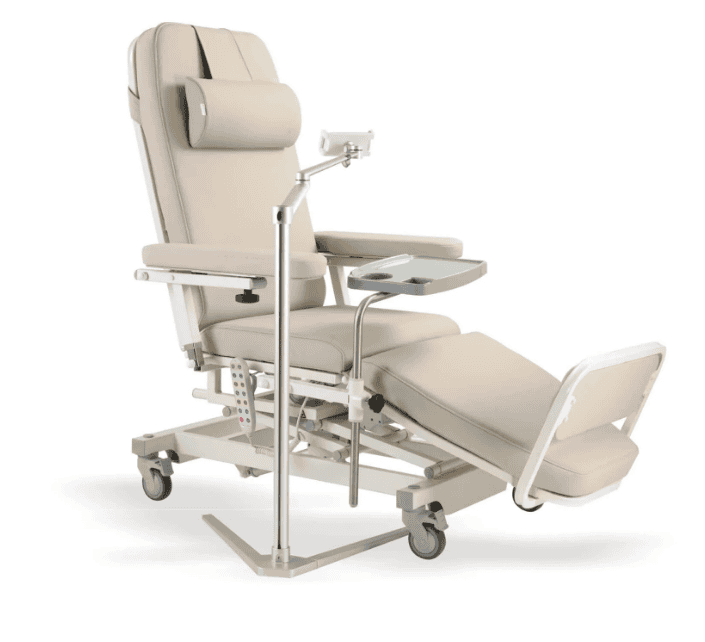
The phlebotomy chair price conversation in India now reflects multi-department clinical adaptability. Electric recliners with adjustable backrest, leg rest, and height controls are serving infusion, oncology, and blood donation settings within a single procurement decision.
Key Takeaways:
- Phlebotomy chair price today reflects multi-procedure adaptability across infusion, oncology, and blood donation settings.
- Multi-motor electric recliners reduce the need for category-specific seating across departments.
- Motor count, upholstery grade, and frame construction are the primary drivers of price differences.
- A higher phlebotomy chair price often supports more departments and reduces the total chairs a facility needs.
- Specification-led procurement lowers long-term maintenance costs and extends the working life of clinical seating.
Blood collection was once a brief procedure. A static armrest chair was enough. That picture has changed across most clinical settings in India. Procurement teams now evaluate seating that covers infusion bays, blood donation, IV therapy, and oncology in a single purchase. The phlebotomy chair price question has grown accordingly, and it carries real weight in buying decisions today.
That shift explains why phlebotomy chair price has moved as a metric. A chair priced above basic pathology seating is not overpriced. It is built to cover multiple departments, with electrically operated adjustments, extended backrest control, and leg rest positioning that a patient in a 45-minute infusion session genuinely needs. Spec drives price. It always has.
When One Chair Can Serve Multiple Departments
- Clinical Range Beyond Routine Pathology: A standard phlebotomy chair is built for speed. Patient sits, blood is drawn, patient leaves. Infusion and oncology are different. Sessions run long, bodies tire, and posture shifts matter. The chair needs to support a patient through an hour or more without the clinical team stopping mid-procedure to manually wrestle it into a new position.
- Department Consolidation and Budget Efficiency: Many hospitals buy separate chairs for dialysis, infusion, and phlebotomy departments. It is not always the right call. One well-specified electric recliner built on a reinforced powder-coated frame can serve across those settings without losing function. Fewer chairs to purchase, fewer maintenance contracts to manage, and a procurement budget that goes further without cutting corners on patient experience.
Why Manual and Static Seating Falls Short
- The Limits of Hand-Crank and Gas-Lift Chairs: Manual repositioning sounds minor until a department handles twelve patients in a shift. Staff crouch, adjust, strain, and repeat. Positioning varies depending on who is on duty. In an infusion suite running back-to-back sessions, that inconsistency is not just a comfort issue. It slows throughput, adds fatigue, and rarely appears in a procurement spreadsheet until something goes wrong.
- Electric Adjustment as a Clinical Standard: Press a button, the chair moves. That is the practical difference. Backrest angle, leg rest extension, seat height — all adjusted without pausing the procedure or asking a second staff member for help. In departments with high patient volumes, that efficiency adds up across every single shift.
Specifications That Justify a Higher Price Tag
- Key Procurement Factors Buyers Often Overlook: Not all electric recliners carry the same capabilities. The gap between a basic motorised chair and a fully adjustable multi-position recliner is considerable, and pricing reflects that gap directly. Before comparing prices, procurement managers benefit from a clear specification checklist. The following factors account for most of the difference in clinical suitability and long-term value:
- Motor count determines clinical range. A single-motor chair adjusts height only. Multi-motor options control backrest, leg rest, and footrest as separate actions, which matters during longer infusion or oncology sessions where patient comfort shifts across time.
- Upholstery grade affects longevity. Clinical chairs face disinfectant contact daily, sometimes multiple times. Materials not rated for that wear begin to crack and peel well before the frame has any issue.
- Access height is a patient safety consideration. A lower seat height reduces physical effort for elderly or mobility-limited patients getting on and off the chair.
- Frame construction determines lifespan. Corrosion-resistant powder coating lasts considerably longer and needs fewer maintenance interventions across a clinical working life.
- Why Cheap Procurement Costs More Over Time: A chair bought on price alone often needs attention within eighteen months. Upholstery splits under frequent disinfection. Motors underperform outside a narrow use case. When that chair cannot flex to a second department, the facility buys another. The initial saving disappears, and the replacement cost lands at a worse point in the budget cycle.
The Chair That Earns Its Place Across Every Department
Choosing on Specification Rather Than Sticker Price: The right seating investment does not just fill a room. It supports a department, reduces staff workload, and lowers replacement costs over time. Clinics evaluating multi-procedure chairs on specification rather than initial price find stronger outcomes across a three to five year procurement window. To explore high-specification electric recliners built for Indian clinical settings, contact a specialist manufacturer directly.
What is the average phlebotomy chair price?
A phlebotomy chair price in India typically ranges from ₹8,000 to ₹48,000 depending on build and functionality. Basic static armrest chairs sit at the lower end. Electric height adjustable chairs with flip and adjustable armrests cost more. The final figure depends on the height adjustment feature, frame construction, and medical grade of the upholstery being used.
Why do phlebotomy chair prices vary?
Operation type and build quality account for most of the difference. A manual or gas-lift chair costs less because it relies on physical effort to reposition. An electric height adjustable chair adjusts independently across multiple points. Upholstery grade and frame coating push the phlebotomy chair price higher.
Is an electric phlebotomy chair worth the investment?
For pathological labs or blood donation centers, yes. Electric height adjustment lets staff work for hours without hurting their back. That efficiency adds up across every shift, and the higher phlebotomy chair price pays back through faster turnaround and lower staff fatigue.
What features affect phlebotomy chair price?
A Basic Phlebotomy Chair is designed for patient comfort and efficient blood collection. It should have a height-adjustable blood drawing arm for optimal venous access, a padded flip armrest with height and depth adjustment, and a height-adjustable elbow rest to support the non-draw arm. The generously padded seat and backrest provide comfort during blood draws, transfusions, and extended procedures, while a fixed footrest promotes stability. Built with heavy-duty sheet metal, tubular metal, and a stainless steel frame, it is powder-coated for durability. The chair should be finished in phthalate-free, antibacterial, fire-retardant upholstery resistant to stains and disinfectants. These features decide the overall cost of the chair.
Can a phlebotomy chair be used for multiple procedures?
A basic phlebotomy chair is best suited for pathological labs and blood donation centers only. For infusion therapies we have IV Infusion Recliner, Chemotherapy Chair and Dialysis Chair.