
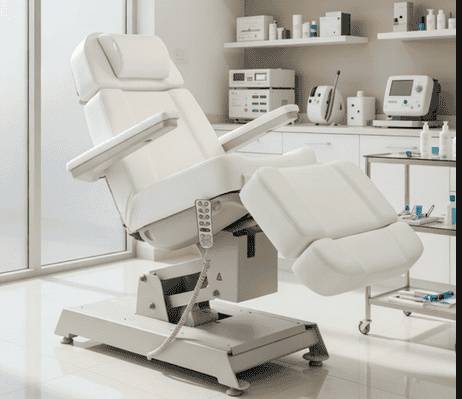
An electric derma chair swaps hand cranks and guesswork for motorised backrest, height, and tilt that you can set with one press. For a busy clinic, the time saved and the impression left on patients can help justify the higher price over time.
Key Takeaways
- A manual chair costs you in small ways that add up: cranking between patients, settling for backrest angles that are only roughly right, and straining to lift heavier patients to working height.
- An electric derma chair runs the backrest, leg rest, height, and tilt on motors, so you setthe desired position and stop there. Models like the four-motor Mridul let you save presets and recall them with one press.
- The downsides are a higher upfront cost, the need for a nearby power point, and occasional motor servicing. A very low-volume room may still get by on a manual chair.
- For a clinic seeing patients all day, the time saved plus the better impression on patientscan help offset the higher price over time.
You have turned the same crank a hundred times this month. Lower the back a little, pump the height up, lock it, then repeat for the next patient. A manual chair works, and plenty of clinics run on one for years. But once you sit a patient in an electric chair and move the backrest with one press, the old way changes. It starts to feel like a chore you no longer want to do. The switch to an electric derma chair changes small things that add up fast. You stop wrestling with levers between appointments. You stop settling for a position that is close enough. Here is what you actually get back when the motors take over the work.
What a Manual Derma Chair Quietly Costs You
A hand crank feels fine on chair number one. By the tenth patient, the cranking and pumping start to wear on you. None of it is dramatic. It just chips away at your day, a minute here, a strained reach there. Manual positioning is rough too. You set an angle by feel, and feel is never exact. So you accept a backrest that is roughly right and work around it. An electric derma chair helps take the guesswork out of that step, since you hold a button until the angle lands and then let go. Over a week of patients, all that rough-enough can add up to a clinic that runs less efficiently.
Precise Positioning: An Electric Derma Chair Gives You
This is the part you feel on day one. An electric derma chair moves the backrest, leg rest, height, and tilt on motors, so you set the angle you want and stop there. There is no guessing and no half-turn correcting.
The Mridul Derma Chair runs on four motors with a programmable handset. You save the positions you use most and recall them with a press. A patient sits, you tap the preset, and the chair is ready before they have settled in. That precision shows in the work, and patients may notice when a clinic runs smoothly.
What Switching to Electric Changes in Week One
The gains are not abstract. They show up in the small habits you drop almost at once.
After the switch, you stop doing this:
- Cranking a handle up and down between every patient
- Settling for a backrest angle that is only roughly right
- Resetting the chair by hand for a returning patient you see often
- Straining to pump a heavier patient up to working height
Add those up across a full clinic, and the saved effort can be significant. The motors handle the work now, and you keep your focus on the patient.
Is an Electric Derma Chair Worth the Switch?
There is a catch, though. An electric chair costs more up front, it needs a power point nearby, and the motors need occasional servicing. For a very low-volume room, a manual chair might still do the job, perhaps for a few more years.
But for a clinic that sees patients all day, the maths often leans electric. The time you save and the impression you leave on patients can help outweigh the higher price over time. A hand-cranked chair may give some patients the impression that your clinic uses older equipment. The smooth glide of an electric one may leave a more modern impression, and that impression can remain long after they leave.