
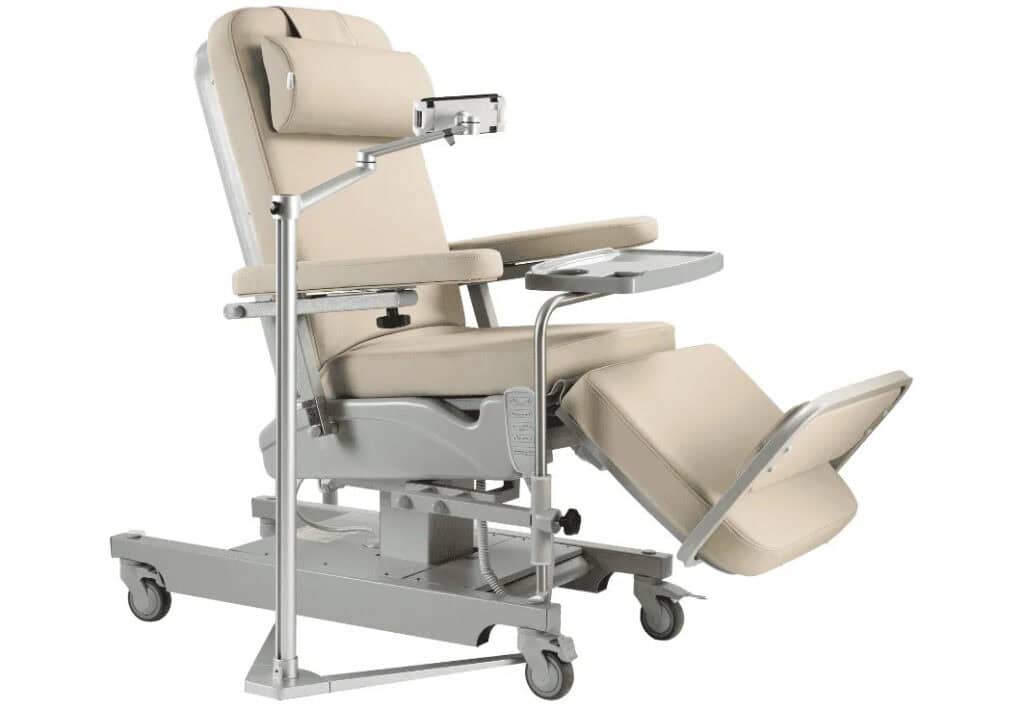
The dialysis chair price a clinic chooses signals its commitment to patient comfort, clinical durability, and long-term operational efficiency. Cheap alternatives tend to cost far more down the line than most procurement teams initially anticipate.
Key Takeaways:
- Pay less upfront on dialysis chair price and the build quality gap shows up fast, often within the first year of clinical use.
- Budget chairs crack, motor systems fail early, and replacement costs pile up in ways that make the original saving look thin.
- A patient shifting around mid-session risks disturbing their vascular access line. That’s a clinical problem, not a comfort complaint.
- Most low-cost options skip essential safety features like Trendelenburg positioning entirely.
- Patients notice comfort. Better seating keeps them returning to the same centre, session after session.
Dialysis sessions run long. Three to four hours in one chair, three times a week, shapes how patients tolerate treatment and how clinical staff manage them through it. The dialysis chair prices a clinic budgets for matters more than procurement teams often admit when they first pull up a quote. The savings look reasonable on a spreadsheet. They rarely hold up once the chair is in daily clinical use.
The dialysis chair price point a facility commits to determines how long that seating actually performs. Disinfectant resistance, motor reliability, frame integrity under sustained load. These aren’t premium features. They’re what keeps a chair functional across five or six years of continuous use rather than two. Buy for the lowest figure available and the replacement cycle starts sooner than any procurement plan accounted for.
What That Cheaper Quote Is Really Hiding
- Frames That Fail Earlier Than Expected: Budget dialysis chairs use lighter steel, simplified motor systems, and upholstery that starts cracking under heavy disinfectant exposure. Not assumptions. Just what procurement managers find when the first service call lands at 14 or 16 months. A chair needing major repair that soon was never a saving. It was a miscalculation from the start, dressed up as a sensible purchase.
- Patient Discomfort Has Clinical Consequences: A patient shifting around during haemodialysis isn’t just restless. Movement risks disturbing the vascular access line, and that creates complications staff have to manage mid-session. Patients who find sessions physically hard to get through are more likely to cut them short or push back attendance. No clinic benefits from that outcome. Cheap seating contributes to it more often than most buying teams realise when reviewing quotes.
Clinical Precision Built Into the Frame
- Motorised Adjustability Changes What Clinicians Can Do: Electronic height, backrest, leg rest, and footrest controls give nursing staff real flexibility during live sessions. Blood pressure drops fast. Repositioning needs to happen faster. A motorised Trendelenburg function responds in seconds. Manual chairs need physical effort and time that clinical situations rarely allow. That difference isn’t just about comfort. It’s about response speed when it actually counts.
- Upholstery Specification Is an Infection Control Decision: Disinfectant-resistant, UV-resistant upholstery isn’t a nice-to-have. Dialysis environments clean surfaces multiple times daily with strong chemical agents. Cheap material degrades within months, cracking in ways that trap pathogens and make cleaning routines unreliable. A chair that can’t survive its own sanitisation process isn’t fit for clinical use, regardless of what it costs to procure.
Numbers That Justify the Spend
- Total Cost of Ownership Tells the Real Story: Replacing a chair every two to three years costs far more than buying correctly once. Freight, downtime, disposal, procurement administration. None of that appears in the original quote, but all of it adds up fast. Spread across a decade of clinical use, the right dialysis chair price point delivers savings that low-cost alternatives simply never match over time.
- Dialysis chair features that justify the upfront investment:
- Electronic height, backrest, leg rest, and footrest adjustment for genuine mid-session clinical flexibility, not just patient preference or basic repositioning.
- Trendelenburg positioning for fast haemodynamic response when blood pressure drops unexpectedly during active treatment.
- Quick-release CPR backrest for emergency chest compression access without needing to relocate the patient at all.
- Disinfectant-resistant, UV-resistant upholstery that survives repeated heavy chemical cleaning without cracking or trapping pathogens beneath the surface.
- Reinforced powder-coated steel built to carry sustained daily clinical load across years of continuous high-frequency use.
- Patients Notice More Than Clinicians Expect: Three sessions a week, for years at a stretch. Dialysis patients know their chair well. A centre running quality seating builds quiet loyalty that facilities cutting corners on equipment don’t earn. In competitive urban markets, patients have real options about where they receive care. Comfort influences that choice more than procurement teams typically account for.
The Chair That Earns Its Place Every Single Day
Quality dialysis seating isn’t an overhead cost. It’s a working clinical asset. Procurement teams that look past the upfront figure and into real operational lifespan tend to reach a different conclusion than those who sort by price alone. The specification matters. The build matters. Get those right and the seating does its job for years without becoming a recurring line item. That’s worth evaluating properly before the next purchase order goes through.
What is the average dialysis chair price?
A dialysis chair price in India usually falls between ₹50,000 and ₹2,50,000. Basic manual models sit at the lower end. Electric chairs with motorised height, backrest and leg rest adjustments cost more. The final figure depends on motor count, frame strength and the infection-control feature a dialysis center needs.
Why does dialysis chair price vary between models?
The variation comes from how the chair moves and what it is built to handle. A simple chair adjusts manually, so it costs less. Models with Trendelenburg positioning, a CPR quick-release backrest, easy ingress and egress, adjustable armrest, IV Pole attachment, and disinfectant-resistant phthalate-free upholstery cost more, because each addition protects the patient and stands up to constant clinical use.
Is an electric dialysis chair worth the investment?
For most centers, yes. An electric dialysis treatment chair allows easy ingress and egress, lets staff adjust height, backrest and leg rest at the touch of a switch, which matters during four-hour sessions and emergencies. The higher dialysis chair cost pays back through faster repositioning, less strain on nurses and better comfort across long treatments.
What features affect dialysis chair price?
Motorization has the biggest effect on chair pricing, since each powered movement adds to the build. After that, safety features like Trendelenburg tilt and a quick-release backrest for CPR raise the figure. Upholstery that resists disinfectants, a reinforced powder-coated frame and low access height all shift the price too.
How long does a dialysis chair typically last?
A well-built dialysis seating system usually lasts eight to ten years with regular maintenance. Lifespan depends on frame quality, motor durability and how well the upholstery holds up to daily cleaning. Precision-welded steel frames and disinfectant-resistant surfaces help a chair stay in service through years of heavy clinical use.