
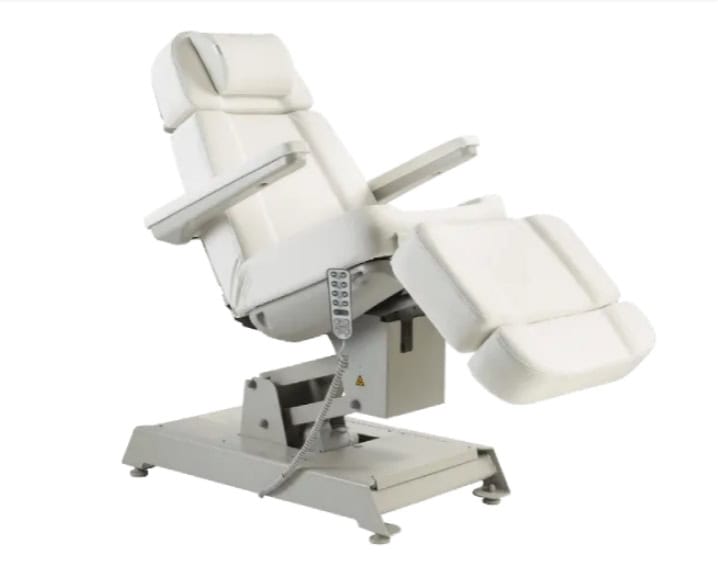
The Derma chair price varies based on motor count, upholstery grade, frame construction, and whether the chair includes a programmable handset. A cheaper chair often costs more over time through faster wear/tear, reupholstering, and lack of after-sales support. Buying for clinical workload rather than choosing the lower upfront cost is what separates a good purchase from a recurring problem.
Key Takeaways
- Motor count is the biggest price driver in a derma chair. A 4-motor chair costs more upfront but gives clinicians full positional control without manual handling.
- Upholstery grade affects long-term cost more than most buyers expect. Clinical-grade surfaces resist disinfectants and daily wear far longer than standard materials.
- Frame construction and manufacturing methods determine how long the chair holds up under daily clinical use.
- After-sales support is part of the real cost. A cheaper imported chair with no service network can sit unused for weeks when a component fails.
If you have ever tried to compare derma chairs online, you already know how confusing it gets. One chair costs forty thousand rupees. Another looks almost identical but costs three times more. The specs sound similar. The photos look the same. Some sellers list features that mean nothing without context, and others leave out information you actually need to make a decision. When you start asking around, the answers are not always clear either. That is where understanding derma chair price becomes useful. So what exactly are you paying for when the price goes up?
The Motor Count Changes Everything
A derma chair with a single motor does one thing. It adjusts the backrest. That is it. A chair with four motors adjusts the backrest, leg rest, height, and tilt independently. Each motor adds to the manufacturing cost, and that cost shows up directly in the derma chair price.
Here is why that matters for your clinic. A single-motor chair forces the clinician to manually reposition the patient mid-procedure. That takes time. It also means your staff are physically handling patients more than they need to. A 4-motor chair like the Mridul Derma Chair from Esthetica Medical Furniture lets the dermatologist adjust every position with a handset, without interrupting the procedure.
That is not a luxury feature. That is a clinical workflow decision.
Programmable Handsets Add Cost, and Save Time
Some derma chairs come with fixed preset positions. Others come with programmable handsets that let each doctor store preferred positions for their specific procedures. If your clinic has two or three dermatologists working different shifts, a programmable handset means no one spends the first three minutes of every session readjusting the chair from scratch.
Programmable systems cost more to manufacture. They also last longer in active clinical use because they reduce mechanical wear from repeated manual override.
Upholstery Grade
Perhaps this one surprises people the most. The fabric or vinyl on the chair surface accounts for a bigger chunk of the price than most buyers expect. Clinical-grade upholstery needs to resist UV exposure, abrasion, and repeated disinfection with chemical agents. Cheaper chairs use standard foam-and-vinyl combinations that begin to crack or discolour within 12 to 18 months of daily use.
When you see a low derma chair price, check what the surface material is rated for. A chair that needs reupholstering every two years is not actually cheaper over its lifetime.
Frame Construction
Precision-welded steel frames with powder coating cost more than basic tube steel frames. The difference shows up after two or three years of daily use. A weaker frame develops a wobble, which is not just an annoyance but downright unacceptable. It creates a positioning problem mid-procedure and a patient safety concern.
CNC-manufactured components fit together with tighter tolerances than hand-cut parts. That affects both the chair’s feel and its long-term durability. Esthetica manufactures derma chairs at its IMT Manesar facility using CNC turning and laser cutting, which is part of why the build quality holds up under clinical use.
What Should You Actually Budget?
A basic manual derma chair will cost you between Rs. 30,000 and Rs. 50,000. An electrically operated derma chair with many motors and clinical-grade upholstery will cost you between Rs. 1,00,000 and Rs. 2,50,000. The Mridul Derma Chair falls in the mid-to-upper range and reflects the 4-motor system, programmable handset, and manufacturing quality that a busy dermatology clinic needs.
Buy for your workload, not just your current budget.
What is the average derma chair price?
A derma chair price in India usually sits between ₹30,000 and ₹2,50,000. Manual models start around ₹30,000 to ₹40,000. Electric versions run ₹50,000 to ₹1,20,000. Four-motor chairs with electronic tilt and programmable positions reach ₹80,000 to ₹1,10,000 depending on build and adjustability.
Why does derma chair price vary between models?
The price difference comes down to how the chair moves and the quality of materials and components used in its construction. Manual chairs rely on levers and mechanical adjustments, making them the most economical option. Electric and four-motor chairs incorporate motorised height, backrest, leg rest, and tilt adjustments, providing greater comfort, precision, and ease of use.
At Esthetica, we use high-quality motors and premium phthalate-free upholstery that is durable, comfortable, and suitable for clinical environments. These superior components, along with robust frame construction and advanced control systems, result in a higher cost compared to low-cost variants available in the market, while delivering better reliability, performance, and longevity.
Does a 4-motor derma chair cost more?
Yes. A four-motor derma chair typically commands a higher price because each motor independently controls a specific movement—height, backrest, leg rest, and tilt—allowing precise positioning without any manual effort. Models such as the Mridul Derma Chair also feature a programmable handset that can store preferred treatment positions, reducing setup time between patients and improving workflow efficiency.
The tilt function is particularly valuable during long dermatological and aesthetic procedures, as it helps reduce stress on the patient's neck and back muscles by providing a more natural and comfortable treatment position. Incorporating a tilt mechanism requires a significantly stronger and heavier frame structure to ensure stability and safe operation throughout the tilt range. For this reason, many standard three-motor chairs do not offer a tilt function, as achieving adequate stability can be challenging without a reinforced frame and base design.
What affects derma chair price the most?
The number and brand of motors used has the biggest effect. The more movements a chair powers electrically, the more you pay. Then comes the brand of motors. Good quality German or Danish Motors are costlier than Chinese brands. After that, frame strength and upholstery quality matter, since clinics need surfaces that resist disinfectants and daily wear. Added features like memory presets and low access height shift the derma chair price upward too.