
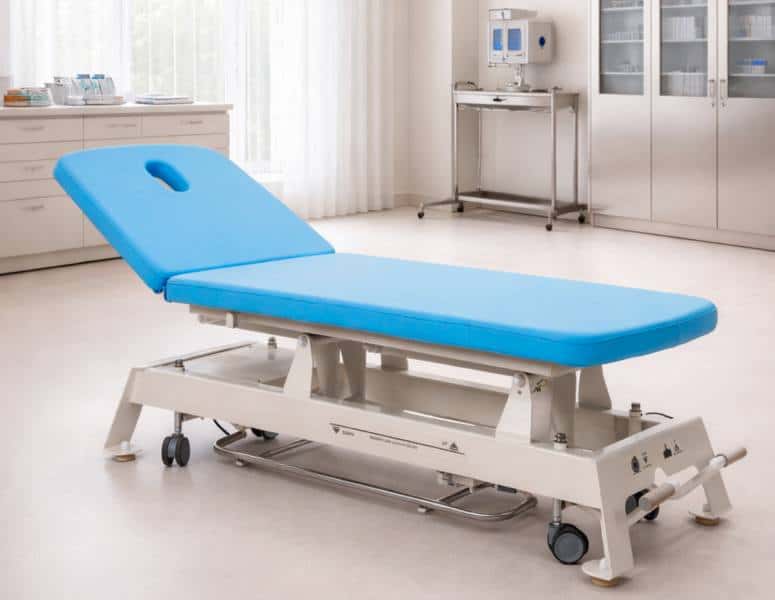
The right examination table price should be as per patient volume, room dimensions and the procedures carried out daily. Matching the table to everyday clinical use protects the budget and keeps every paid-for feature working.
Key Takeaways
- Matching the table to the clinical setting makes any examination table price easier to justify.
- Patient volume decides how much powered adjustment earns its keep.
- Room clearance matters as much as the footprint.
- Weight capacity and height range need checking against real patients.
- Unused features are money the room could have used better.
Two clinics can buy the same table and end up with completely different values from it. One uses every position on the handset. The other never moves it past a fixed height. A sensible examination table price starts with a clear picture of what happens in the room each day.
A well-judged examination table price reflects the work the table will actually do, not the length of its feature list. Clinics that check caseload and room dimensions before shortlisting models end up with equipment that earns its place. That homework also makes supplier quotes far easier to compare, line by line.
What Happens in the Room Shapes the Shortlist
- Procedure Mix Comes First: A general practice running quick consultations needs a stable surface at a comfortable working height and little else. Dermatology and gynaecology rooms ask for more. Tilt, section breaks and leg rest movement matter there, because the clinician spends longer at the table and needs the patient held in a precise position.
- Frequency of Use Changes the Maths: A table used forty times a day wears differently from one used four times. Motorised height adjustment looks costly on paper until staff are raising and lowering the surface all shift. Where the table rarely moves, that money does more good elsewhere in the room.
Busy Mornings Expose Every Slow Adjustment
- Throughput Sets the Pace: High patient volume rewards tables that reposition quickly and reset between appointments without fuss. Foot switches and walk-free controls save seconds that add up across a full list. A clinic seeing thirty patients before lunch feels every extra crank of a manual mechanism, and the waiting room feels it too.
- Room Size Decides the Layout: Measure the clearance around the table, not only the footprint. Staff need room to work on both sides, and a trolley or stool has to pass without knocking against anything. Narrow consultation rooms suit a compact two-section model far better than a wide seven-section table.
Numbers Worth Checking before the Order Goes Out
- Weight Capacity and Frame Strength: Safe working load covers the patient and anything applied during the procedure. A rating that sits close to the average patient weight leaves nothing spare. Precision-welded steel frames and powder-coated finishes hold their shape under repeated loading, which is where a fair examination table price shows its value over years of use.
- Height Range and Access: Low access height helps elderly patients and anyone with limited mobility get on and off without assistance. The top of the range matters for the clinician who works standing through a long list. A table that meets only one end of that range forces a compromise staff notice daily.
- Table width against the procedures performed, since a wider top steadies larger patients but eats floor space.
- Section count. Two, three, five or seven, matched to how the body is positioned during treatment.
- Upholstery that survives daily disinfectant without cracking.
- Motor count, and whether every powered function will genuinely be used.
Buy for the Practice You Actually Run
The right table disappears into the working day. Nobody thinks about it, because it does what the room needs without argument. Send a supplier the caseload, the room measurements and the procedures performed, then ask for models built around those answers. Quotes matched to real use are always the ones worth signing.