
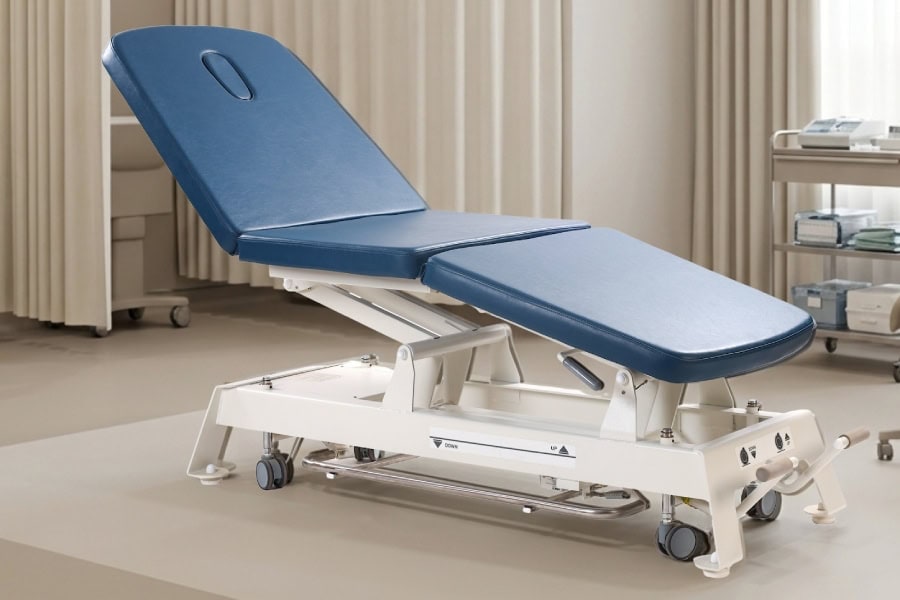
A Hi Lo treatment table helps clinics position patients more easily and set a comfortable working height for staff, with section adjustment adding flexibility across physiotherapy and general treatment rooms.
Key Takeaways
- Height adjustment can help reduce the time needed for setup between patients.
- A hi lo treatment table lowers for easier patient access and rises for the clinician.
- Adjustable head, back and leg sections widen what one room can handle.
- Gas spring assistance speeds up manual repositioning on selected models.
- Frame build and motor quality are important factors when considering how long the table is expected to last.
Patient positioning takes up more of a clinical session than most planners expect. Transfers, procedure setup and repositioning all add minutes to this process. A Hi Lo treatment table gives clinics a practical way to handle that load, since the surface moves to suit the patient and the clinician rather than the other way round.
A Hi Lo treatment table lowers to facilitate easier patient access and rises to a comfortable working height for the clinician. That range matters across a full list. Staff can spend less time bending awkwardly, while patients can access the table more easily depending on their mobility and clinical needs.
When a Fixed Height Slows the Whole List Down
- Repeated Positioning Adds up across a Session: Ten patients in a morning means ten different setups. Each one needs the surface at a workable level for the procedure being carried out on any given patient. When the height cannot change, staff compensate by leaning, kneeling or asking patients to shift themselves further than they should comfortably manage. Those minutes rarely appear in any log.
- Fixed Surfaces Force Awkward Working Postures: Physiotherapists and examining clinicians work with their hands for long stretches. A surface set too high shortens their reach. Too low, and the back can take the strain. Neither problem announces itself on day one, yet both can affect staff comfort over months of full clinic lists. A table that allows the working height to be adjusted gives the practitioner another option for setting up the treatment position.
Height Adjustment That Works for Patient and Practitioner
- Low Access Height Makes Transfers Simpler: Dropping the surface closer to the floor can make it easier for a patient to get on. Older patients, those with limited mobility and anyone recovering from surgery may find a lower access position more convenient, depending on their individual needs. Patients can sit down at a more accessible level and then be raised into position where appropriate.
- A Working Height Set to the Clinician, Not the Furniture: Motorised height adjustment lets each practitioner set the surface where their own posture works best. A tall physiotherapist and a shorter colleague can share the same room across back-to-back shifts. One press of a foot control can adjust the level between patients on models equipped with this feature, and the walk-free switch on some models keeps hands free.
Positioning Features Worth a Second Look at the Specification Stage
- What to Check on the Specification Sheet: Height range alone does not tell the full story. Section adjustment, control type and load capacity all shape how the table performs once it is in daily use. Procurement teams who compare only headline figures may find that out later, after installation. The specification sheet repays a slow read, line by line.
-
- Height range at both ends, since a low access position matters as much as a high working one.
- Section count. Two, three or seven, depending on the procedures planned.
- Gas spring assistance on head and back sections for quick manual repositioning.
- Control options, whether foot switch, hand control or a walk free bar around the base.
- Upholstery specified to withstand the cleaning and disinfection requirements of the clinic.
- Load Capacity and Frame Build Decide the Lifespan: Precision welded steel frames with powder-coated finishes are important for tables used through repeated adjustment cycles. Motors work harder in a busy clinic than in a showroom. For this reason, frame construction, motor quality and the specifications of the individual components are important considerations when selecting a table for regular clinical use.
Where Height and Section Control Meet in Physiotherapy Rooms
- Mobilisation Work Needs the Surface to Move Too: Manual therapy asks the clinician to apply force through the hands and body weight. Getting the patient to the right level can make that work more practical and comfortable for the clinician. A hi-lo treatment table paired with adjustable head, back and leg sections gives physiotherapists both variables to set before treatment starts.
- One Room, Several Disciplines: Multi-use treatment rooms carry a mix of examination, rehabilitation and minor procedure work. Section adjustment turns a flat plinth into a seated examination position in seconds on suitable models. Rooms fitted this way can accommodate a wider range of appointment types, which can make better use of the available treatment space. That can favour adjustable models where flexibility is important.
Positioning Sorted before the First Patient Arrives
Clinics that get positioning right stop noticing it, which is the point. Staff can adjust the table to the required working position, patients can be positioned according to the procedure, and the schedule can run with fewer positioning changes to manage. Specify the height range and section options against the procedures actually carried out in each room, then speak to a manufacturer that builds its own frames and can talk through the options properly.